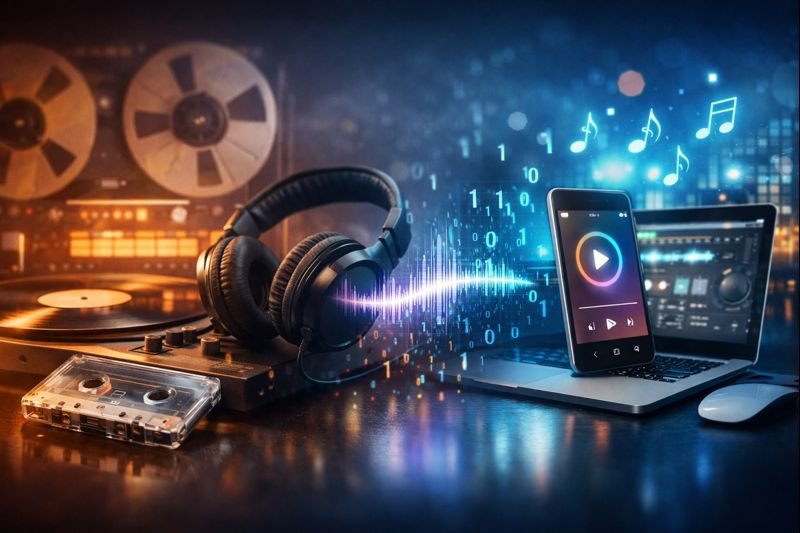
Music has always evolved alongside humanity. From tribal drums echoing across ancient landscapes to vinyl records spinning in mid-century living rooms, every era reshaped how music was created, shared, and experienced. But no transformation has been as rapid—or as disruptive—as the evolution of music in the digital age.
In just a few decades, music has shifted from physical ownership to instant access, from studio exclusivity to bedroom production, and from industry gatekeeping to global self-distribution. This digital revolution didn’t just change formats; it rewired the entire music ecosystem.
Life Before Digital: A Brief Context
Before the internet, music distribution followed a linear path. Artists recorded in professional studios, labels pressed physical copies, and listeners bought albums from record stores. Discovery relied on radio stations, MTV, magazines, and word of mouth.
This system created legends—but it was also slow, expensive, and inaccessible for many aspiring musicians.
The arrival of digital technology changed everything.
The Birth of Digital Music and the MP3 Revolution
The late 1990s marked a turning point. The introduction of the MP3 format allowed music files to be compressed and shared online with ease. Platforms like Napster exposed a new reality: music could travel faster than the industry could control it.
While controversial, this moment laid the foundation for modern digital music consumption. It forced record labels to rethink ownership, distribution, and pricing—and opened the door for innovation.
Key impacts of early digital music:
- Shift from physical to downloadable formats
- Rise of peer-to-peer sharing
- Decline in CD sales
- Growing demand for instant access
Though chaotic, this era democratized music in unprecedented ways.
Streaming Platforms Redefined How We Listen
If downloads cracked the door open, streaming blew it off its hinges.
Services like Spotify, Apple Music, and YouTube transformed music from a product into an experience. Instead of buying albums, listeners gained access to millions of tracks on demand.
This shift fundamentally altered listening habits:
- Playlists replaced albums
- Algorithms influenced discovery
- Global audiences became reachable overnight.
- Music became more personalized than ever before
The evolution of music in the digital age is inseparable from data. Today, listening behavior actively shapes what music gets promoted, produced, and even written.
Social Media Changed Who Gets Heard
Digital platforms didn’t just change listening—they changed who gets discovered.
Artists no longer need major label backing to reach millions. TikTok, Instagram, and YouTube have launched careers from viral smartphone clips.
Some of today’s biggest hits didn’t start on the radio—they began on social feeds.
This shift empowered:
- Independent musicians
- Niche genres
- Global cross-cultural sounds
- Direct artist-fan relationships
Music is no longer filtered through a single cultural lens. The digital age made it borderless.
Home Studios and the Democratization of Music Production
Perhaps the most profound change in the evolution of music in the digital age is how music is made.
What once required expensive studios can now be done on a laptop. Digital Audio Workstations (DAWs), virtual instruments, and AI-assisted tools allow artists to produce professional-quality music from anywhere.
This accessibility led to:
- Explosive genre experimentation
- Faster release cycles
- Creative independence
- A surge in DIY artistry
Talent and creativity matter more than access to expensive equipment.
Artificial Intelligence and the Future of Music
AI is the newest chapter in the evolution of digital music. From mastering tracks to generating melodies, technology is now collaborating with human creativity.
While debates around authenticity continue, AI tools are increasingly used to:
- Enhance production efficiency
- Analyze audience preferences
- Assist with songwriting and sound design.
Rather than replacing musicians, AI is becoming another instrument—one shaped by human intention.
Challenges of the Digital Music Era
Despite its advantages, the digital age also brought challenges:
- Lower artist payouts from streaming
- Oversaturated markets
- Shorter attention spans
- Algorithm dependency
Success today requires not just musical talent, but branding, consistency, and digital literacy.
Yet even with these obstacles, the opportunities far outweigh the limitations.
Why the Digital Evolution of Music Matters
Music is more than entertainment—it reflects culture, emotion, and identity. The digital age didn’t dilute music’s value; it amplified its reach.
Never before has music been:
- This accessible
- This diverse
- This interconnected
The evolution of music in the digital age represents a shift from control to community, from scarcity to abundance, and from passive listening to active participation.
Final Thoughts
The story of music’s digital evolution is still being written. New platforms, technologies, and creative models continue to emerge, reshaping how sound connects us.
What remains unchanged is music’s purpose: to express, to inspire, and to unite.
The tools may evolve—but the heartbeat of music stays human.