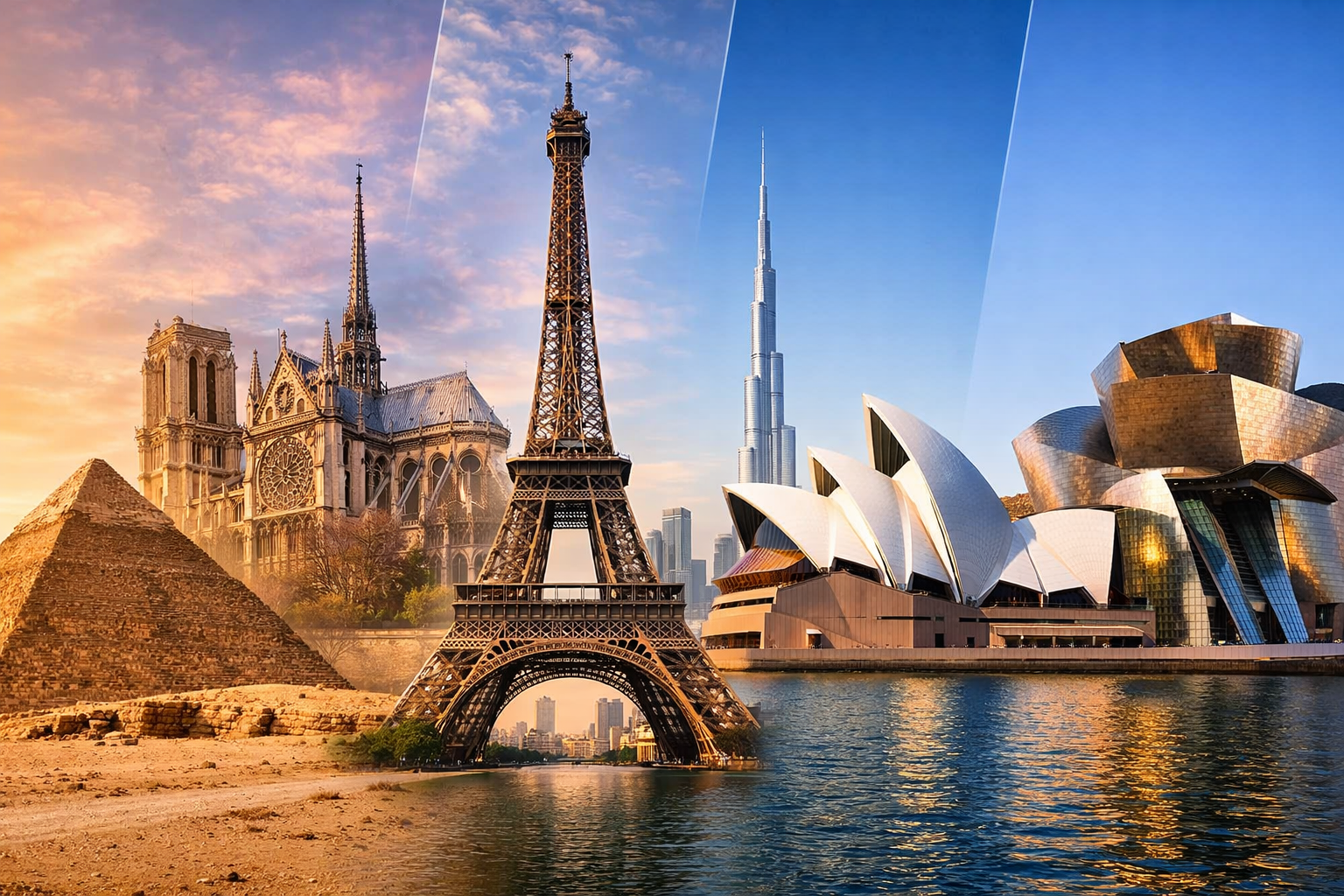
Architecture is more than walls and roofs—it is a record of human ambition, creativity, and progress. Throughout history, a handful of structures have gone beyond serving their immediate function to reshape how buildings are imagined, designed, and constructed. These iconic buildings changed architectural history by introducing new materials, defying old rules, and inspiring generations of architects.
From ancient wonders to futuristic landmarks, let’s explore the buildings that didn’t just reflect their time—but transformed it.
Why Iconic Buildings Matter
Iconic buildings are not simply famous—they are influential. They introduce new ideas, challenge conventions, and often mark turning points in architectural thinking.
These buildings:
- Redefine what is structurally possible.
- Introduce new materials or construction methods.
- Shift design philosophies
- Influence urban planning and global styles.
Without them, modern skylines and contemporary design would look very different.
1. The Great Pyramid of Giza (Egypt, c. 2560 BCE)
Long before steel and concrete, ancient Egyptians constructed a structure that still amazes engineers today.
The Great Pyramid:
- For more than 3,800 years, it was the tallest artificial building.
- Used over 2 million stone blocks
- Demonstrated advanced surveying and engineering skills
Its precise geometry and monumental scale proved that architecture could be both scientific and symbolic, setting the foundation for all subsequent monumental buildings.
2. The Pantheon (Rome, 126 CE)
The Pantheon is one of the most important buildings in Western architectural history.
Its concrete dome—with a 43-meter span—remains the largest unreinforced concrete dome in the world. The oculus at its center allows light to pour into the interior, creating a spiritual, almost cosmic atmosphere.
The Pantheon:
- Perfected the use of Roman concrete
- Introduced massive interior spaces
- Influenced churches, capitols, and museums for centuries
Nearly every domed building today traces its lineage back to this Roman masterpiece.
3. Notre-Dame Cathedral (Paris, 12th–14th Century)
Gothic architecture found its greatest expression in Notre-Dame.
Notre-Dame’s ribbed vaults, flying buttresses, and pointed arches allowed for the construction of churches that were higher, lighter, and more radiant than ever before.
Its impact:
- Changed how weight was distributed in buildings
- Allowed walls to be filled with stained glass
- Created the vertical, heavenly feel of Gothic cathedrals
Without Notre-Dame, European architecture might never have reached such poetic heights.
4. The Crystal Palace (London, 1851)
Built for the Great Exhibition, the Crystal Palace was a radical departure from stone and brick.
It was:
- Made almost entirely of glass and iron
- Prefabricated and assembled in record time
- One of the first true modern buildings
This structure proved that industrial materials could create beautiful, functional spaces—and launched modern architecture into the machine age.
5. The Eiffel Tower (Paris, 1889)
Once criticized as an eyesore, the Eiffel Tower changed how the world viewed exposed structure.
Instead of hiding iron behind stone, Gustave Eiffel celebrated it. The tower showed that engineering itself could be art.
It inspired:
- Skyscraper construction
- Open-frame structures
- A new appreciation for industrial design
Today, it is not only a Paris icon but also a symbol of modernity.
6. Fallingwater (Pennsylvania, 1935)
Frank Lloyd Wright’s Fallingwater redefined how buildings relate to nature.
Built over a waterfall, it:
- Blended architecture with landscape
- Used cantilevered concrete to float above nature
- Rejected rigid, box-like forms
This building helped establish organic architecture—where design flows with the environment instead of fighting it.
7. The Seagram Building (New York City, 1958)
Modern skyscrapers owe much of their look to the Seagram Building.
Ludwig Mies van der Rohe’s design introduced:
- Clean lines and minimalism
- Exposed steel structure
- A new standard for corporate architecture
It replaced decorative excess with elegant simplicity, shaping cities across the globe.
8. The Sydney Opera House (Australia, 1973)
With its sail-like shells, the Sydney Opera House transformed how buildings could look.
Its innovative design:
- Pushed the limits of concrete engineering
- Turned architecture into sculpture
- Created a new visual language for public buildings
It proved that functional spaces could also be breathtaking works of art.
9. The Guggenheim Museum Bilbao (Spain, 1997)
Frank Gehry’s titanium-clad masterpiece didn’t just change architecture—it changed an entire city.
The Guggenheim:
- Made sculptural, deconstructed design mainstream
- Sparked the “Bilbao Effect,” where iconic buildings revive cities
- Used advanced digital modeling to shape complex forms
It showed that architecture could be a powerful economic and cultural force.
10. Burj Khalifa (Dubai, 2010)
The tallest building on Earth redefined what skyscrapers could be.
The Burj Khalifa, which is more than 828 meters high:
- Uses advanced wind engineering
- Introduced new vertical city planning
- Represents the future of megastructures
It marks humanity’s ongoing desire to reach higher—both literally and creatively.
How These Iconic Buildings Changed Architecture Forever
Each of these landmarks did something revolutionary:
- Ancient structures mastered geometry and mass
- Gothic cathedrals reshaped light and height.
- Industrial buildings introduced modern materials.
- Contemporary icons pushed form beyond tradition.
Together, they tell the story of architecture as an evolving dialogue between imagination and technology.
Final Thoughts
The iconic buildings that changed architectural history are not just impressive—they are transformational. They altered how we build, live, and see the world around us.
From stone pyramids to glass towers, these structures prove that architecture is one of humanity’s most powerful expressions. The iconic structures of the future are already waiting to be envisioned as cities continue to expand and technology develops:
If history teaches us anything, it’s this: the next building that changes everything is only one bold idea away.